Acorn
An empty repository to a deployed estate-agency CRM in 7 hours and 3 minutes, built overnight by parallel agents while the human slept.
Fifteen modules, thirty four database tables, a five-role permission system and a full audit log. Roughly forty minutes of human prompting. Every number below names how it was measured.
Visit the live product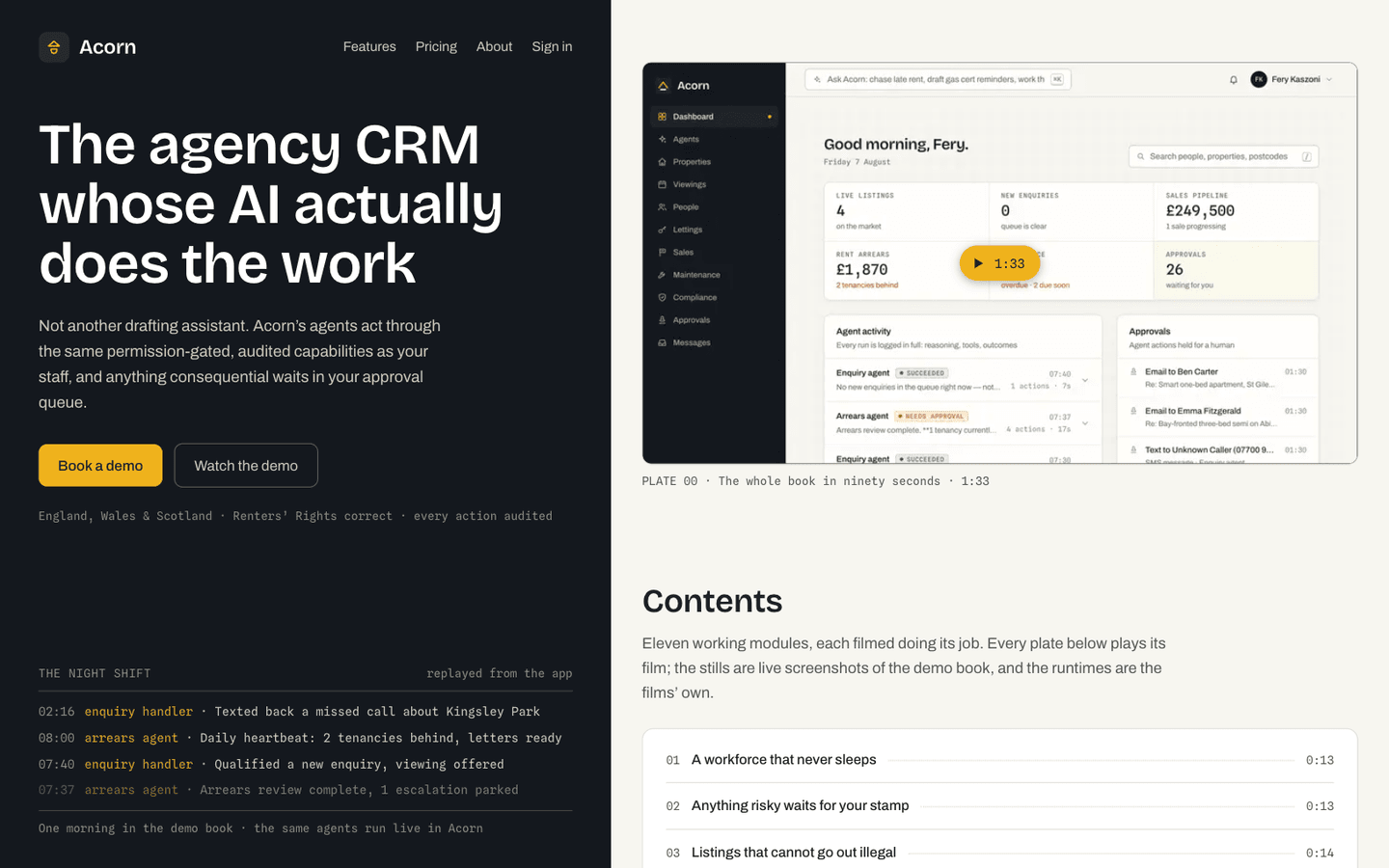
The run
- 01:15First commitEmpty repository. 7 August 2026, 01:15:31 BST.
- 01:15 – 08:18Parallel agents buildSeparate quadrants, separate worktrees, coordinating with each other.
- 08:18Live in productionFirst production deployment, 08:18:44 BST. 7h 3m elapsed.
- 12:44Application completeLast commit to the CRM repository.
- 14:43Marketing site completeacorncrm.co.uk finished the same afternoon.
The receipts
Line counts are product code only: dependencies, lockfiles, binary assets and the vendored .claude agent tooling are excluded. Counts are across both repositories (the application and the marketing site) as of 2026-08-08.
Acorn is a working estate-agency CRM: properties, lettings, sales, viewings, maintenance, compliance, approvals, contractors, people and an AI-agent layer, behind a five-role permission system with a full audit log. It went from an empty repository to a deployed production application in seven hours and three minutes, overnight, while the person who commissioned it was asleep.
The interesting part is not the speed on its own. It is that the work was done by a fleet of Codus agents running in parallel quadrants, each holding its own repository worktree and terminal, coordinating with one another rather than queueing behind a single session. The human contribution was roughly forty minutes of prompting spread across the evening, and then sleep.
What the timeline actually shows
The first commit lands at 01:15:31. The first production deployment goes out at 08:18:44 the same morning. Both timestamps are machine-generated rather than reported: the first from git, the second from the Vercel deployment record. Seven hours and three minutes separate them, and nobody was awake for most of it.
Work continued after the site was live. The application picked up its last commit at 12:44 and the marketing site at 14:43, so the full day runs to about thirteen and a half hours. We quote the seven hours because that is the figure with a deployment record attached to it, and because "live" is the claim that means something.
What got built
Fifteen functional modules plus a design styleguide: properties, lettings, sales, viewings, maintenance, compliance, approvals, contractors, enquiries, messages, people, agents, dashboard, search and settings.
Thirty four database tables, from properties and tenancies through to audit_log, agent_runs and landlord_statements.
A five-role permission system covering director, branch manager, negotiator, property manager and accounts, enforced through a single audited capability write-path rather than scattered per-route checks.
An approval queue, background workers and a full audit log, because a CRM that moves money and tenancy state needs the boring infrastructure as much as the screens.
Why we publish the method with the numbers
Every figure on this page names how it was measured, and the two that are judgements rather than counts are labelled as such. That is deliberate. The first draft of this case study carried a claim of forty five thousand lines of code, which turned out to be counting a vendored agent-tooling directory that had been committed into the marketing repository. The real figure is about twenty seven thousand lines of product code.
We corrected it before publishing, and we are telling you about it here, because a page headed "with the receipts" is worth nothing if the receipts do not reproduce. Clone the repositories, run the counts, and you should land where we landed.
Built with
- Next.js
- TypeScript
- PostgreSQL
- Tailwind CSS
- Vercel
Build yours the same way.
Codus is out now on macOS.