Muse Code vs Claude Code and Codex: what Meta’s own benchmarks actually say
Meta shipped its first coding agent this morning, and within the hour my feed had already decided it was either a Claude Code killer or a nothingburger. Both verdicts were written before anyone had opened the benchmark charts Meta published alongside it, so I spent the morning reading those instead, and the numbers turn out to be considerably more interesting than either take.
The short version: Meta published three benchmark charts, and Claude Opus 5 comes first on all three, including the benchmark Meta built itself. That is a genuinely unusual thing for a launch post to do, and almost none of the coverage mentioned it. But the more useful finding is the one underneath: Muse Code beat Codex on Terminal-Bench on day one, at roughly a quarter of the token price, which makes this a serious fight for second place rather than a challenge to the leader.
Here is everything Meta announced, what the numbers actually support, where the asterisks are, and whether I think you should install it.
What Meta actually shipped
Muse Code is a terminal coding agent, in beta, on macOS and Linux, powered by a new model called Muse Spark 1.2. It is the first coding agent out of Meta Superintelligence Labs, the group run by Alexandr Wang, and Mark Zuckerberg described it plainly enough:
It’s a terminal coding agent that takes on complete software engineering tasks across large repos: planning changes, writing code, validating the results.
You install it with a single line, which will look familiar to anyone who has set up a CLI agent before:
curl -fsSL https://dev.meta.ai/install.sh | bash
The architecture is the part worth reading twice:
Persistent background agents. Rather than spawning a fresh subagent per task and throwing it away, Muse Code keeps async agents alive across the session so they accumulate context as you work.
Parallel sub-agents in isolated worktrees. When a task is large enough, it splits into sub-agents that work simultaneously, each in its own git worktree so they cannot overwrite each other.
A local event log. Every model call, tool run, approval and edit is written to disk, which gives it a replay-exact and restart-safe runtime. If it crashes mid-run, it picks the session back up.
Three bundled skills.
/planproduces an approval-gated plan,/grillstress-tests that plan, and/goalruns until a stated objective is met.
Muse Spark 1.2 itself was co-trained with the agent rather than shipped separately and wrapped afterwards, trained on long-horizon work including whole-repository generation, and improved through a loop where Spark 1.1 generated hard coding environments for 1.2 to learn on. Notably, there is no desktop app. Unlike Claude Code and Codex, this is terminal-only for now.
The chart nobody quoted
Meta published three benchmark charts. Every headline I read picked the flattering sentence out of them, the one saying Muse Spark 1.2 beats Grok Build 4.5 and Gemini 3.6 Flash. That is true. It is also the least interesting thing on the page.
Start with Terminal-Bench 2.1, the benchmark that most closely matches what these tools actually do:
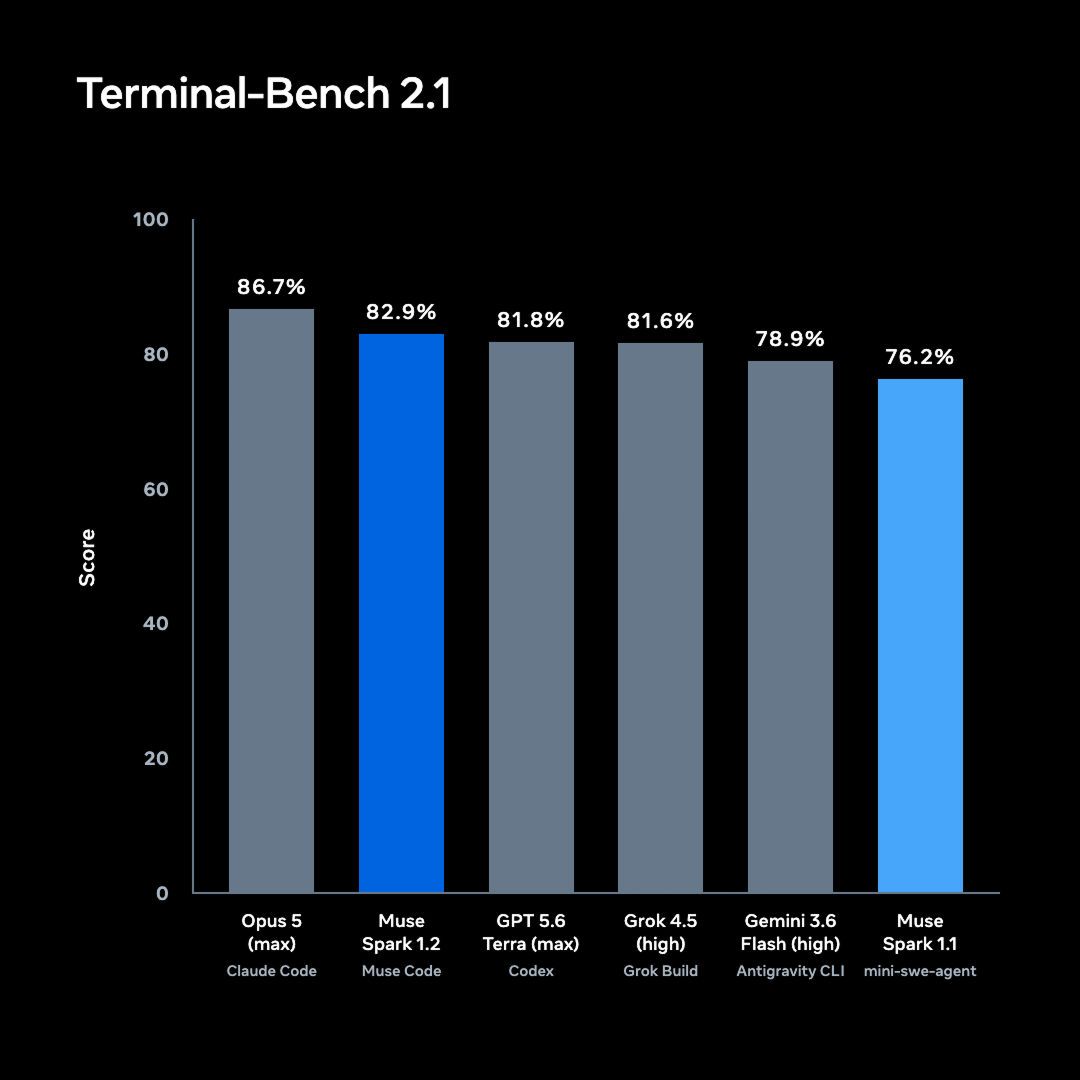
Muse Code takes second at 82.9%, behind Claude Code on Opus 5 at 86.7%, and ahead of Codex on GPT 5.6 Terra at 81.8%. A 3.8-point gap to the leader on a day-one beta is a real result, and beating Codex, even by a point, is the headline Meta earned but did not lead with.
Then DeepSWE 1.1, which measures long-horizon agentic work, and where the picture changes:
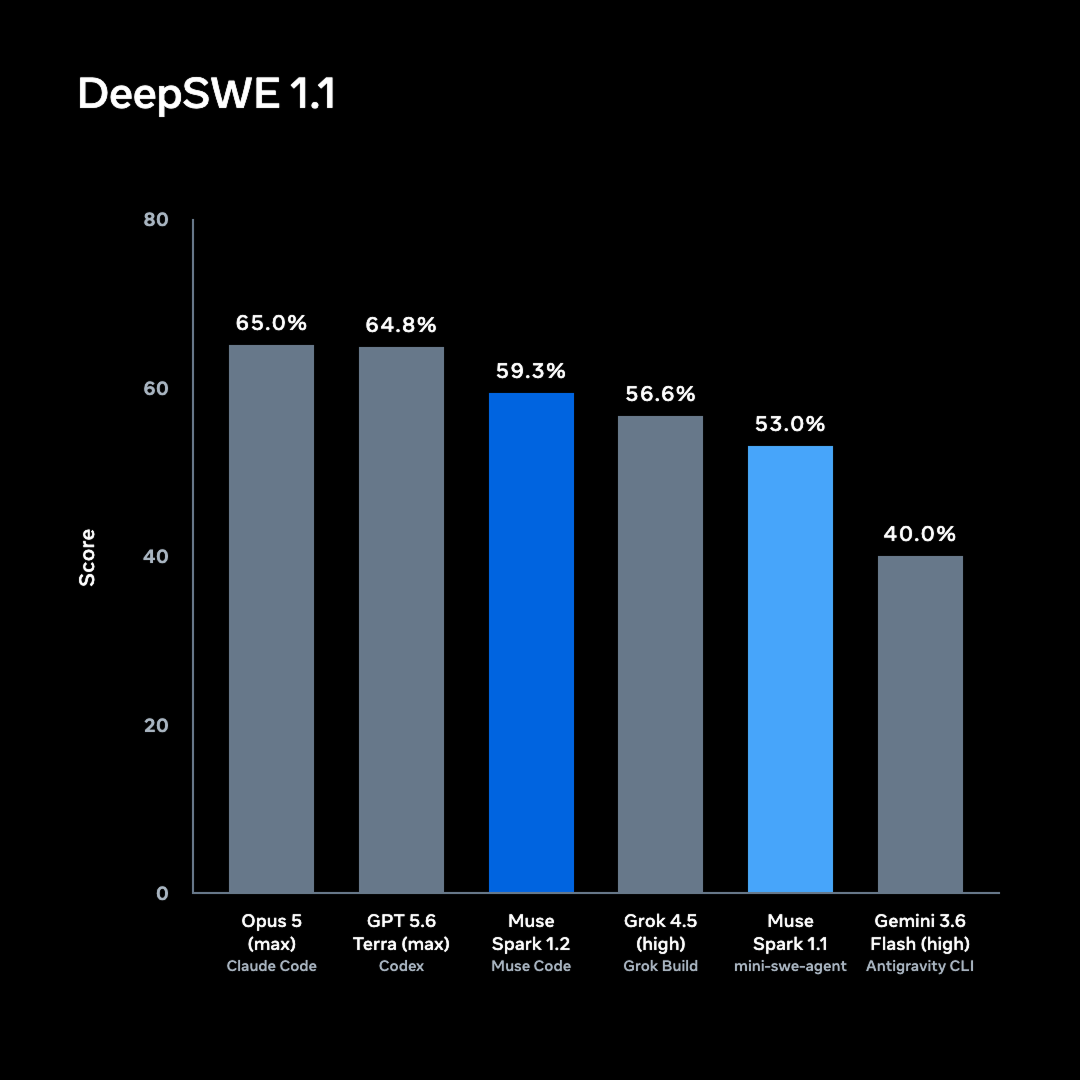
Here Muse Code drops to third at 59.3%, with Claude Code at 65.0% and Codex at 64.8% effectively tied at the top. The longer the horizon, the further Muse Code falls behind, which matches what the benchmark is designed to expose, and matters enormously if you plan to hand an agent an overnight job rather than a twenty-minute one.
And then the chart I did not expect Meta to publish at all, its own internal coding benchmark:
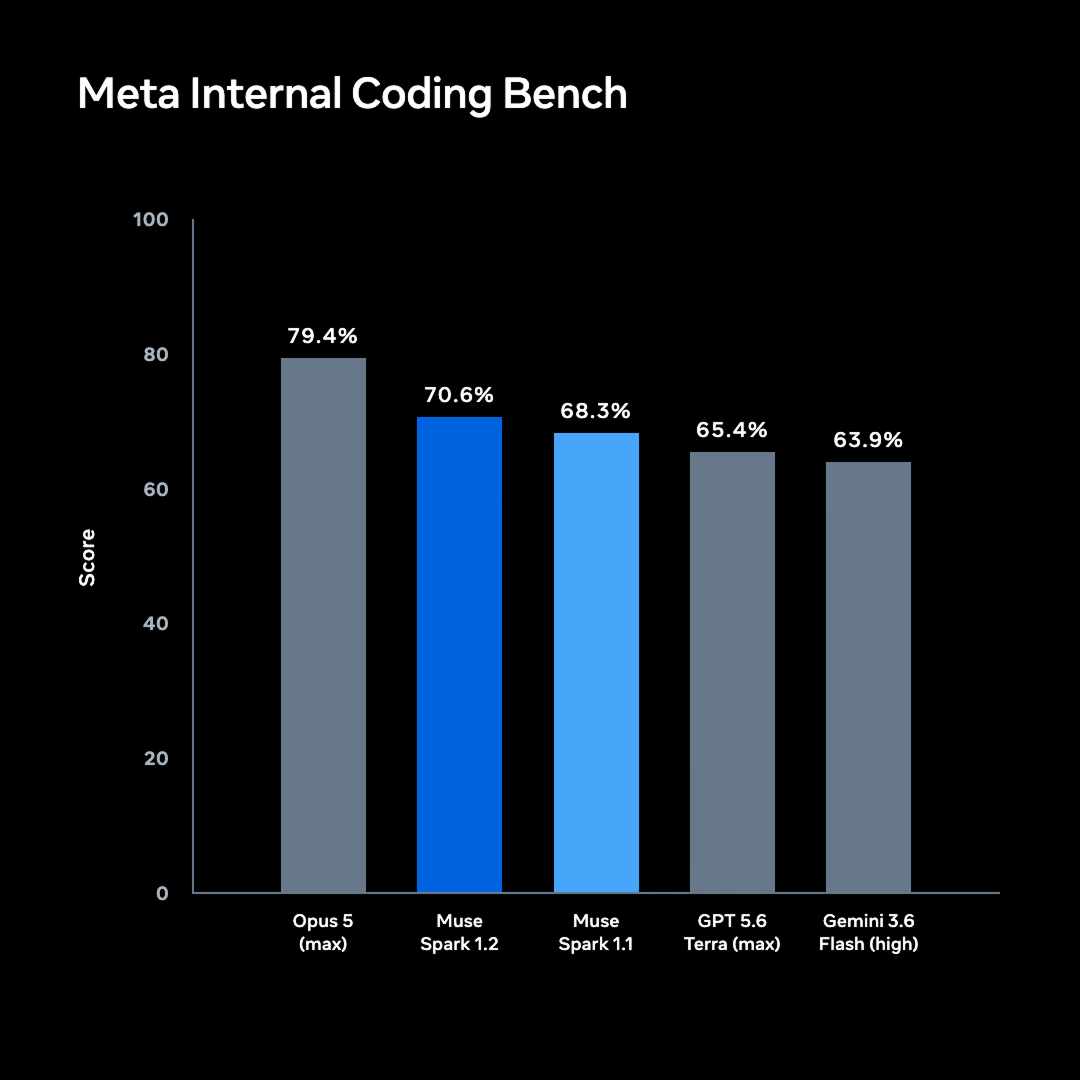
On a benchmark Meta designed, curated and ran in-house, Claude Opus 5 scores 79.4% against Muse Spark 1.2’s 70.6%. An 8.8-point deficit on your own eval, published voluntarily in your own launch post, is either remarkable candour or a quiet admission that the frontier is still somewhere else. I lean towards candour, and I would rather have a vendor that publishes the chart it loses than one that does not run the comparison.
Three asterisks worth knowing about
Benchmarks reward whoever chooses the comparison set, so before treating any of this as settled, three things deserve flagging.
Meta benchmarked against Terra, not Sol. Every OpenAI bar in those charts is GPT 5.6 Terra, the mid-tier model, rather than GPT 5.6 Sol, the flagship. Developers on Hacker News spotted this within minutes, and one pointed out that in Meta’s own GPU kernel case study, Sol appears to come out ahead. So the Codex numbers above are the ones Muse Code chose to stand next to, not the strongest ones available.
These are agent-and-model scores, not model scores. Look at the small print under each bar: Opus 5 ran inside Claude Code, GPT 5.6 Terra inside Codex, Spark 1.2 inside Muse Code. That is arguably the honest way to compare products, because it is how you will actually use them, but it means you cannot read these as pure model rankings, and the harness is doing part of the work in every bar.
Part of the 1.1 to 1.2 jump is a harness change. On Terminal-Bench, Spark 1.1 is scored at 76.2% running on mini-swe-agent, a deliberately minimal harness, while 1.2 is scored at 82.9% running inside the purpose-built Muse Code. That 6.7-point improvement is a model gain and a tooling gain added together, and the chart does not separate them. This is the number I would most want to see re-run independently.
Developer reaction has been correspondingly measured rather than breathless. The Hacker News thread settled around "a nice release and a solid improvement over Spark 1.1, not SOTA, but solid", with a side of scepticism about a 1.2 arriving less than a month after 1.1, and a recurring, entirely predictable question about whether developers want to hand Meta a live feed of their codebase.
The price is the actual story
Muse Code runs at $1.25 per million input tokens and $4.25 per million output tokens, which undercuts frontier pricing by roughly four to one, and there is $20 of free credit to start. For a lot of teams that difference is the whole argument, because agentic coding burns tokens at a rate that makes per-million pricing the dominant line item rather than a rounding error.
Then there is the contributor tier, which Meta says is more than ten times cheaper again, and this is where I would slow down. That price is not a discount, it is a trade: you opt in to your usage improving the model. Meta describes this as industry-standard for coding agents, which is fair, and zero-data-retention is available on request, which Wang has called an important enterprise feature. But "available on request" is doing a lot of work in that sentence, and the default posture for anyone touching client code, licensed source or anything under NDA should be to assume the cheap tier is not for them.
Put plainly: at four times cheaper you are buying a genuinely competitive agent at a real discount. At forty times cheaper you are paying with your repository.
So is it a threat to Claude Code or Codex?
Not to Claude Code, on this evidence, and Meta’s own charts are the reason I can say that without hedging. Claude Opus 5 leads on Terminal-Bench, leads on DeepSWE, and leads on Meta’s in-house benchmark, and the gap widens precisely as tasks get longer, which is the direction the whole category is moving. If your work is long-horizon, multi-file, hand-it-over-and-walk-away engineering, nothing here should change your setup.
To Codex, though, I think it genuinely is. Muse Code arrived at parity on Terminal-Bench, in beta, on day one, at a quarter of the price, and it did so with an architecture that is well suited to exactly the medium-sized parallel work that mid-tier pricing invites. OpenAI’s answer will presumably be Sol rather than Terra, but the pressure is now on price as much as capability, and that is a fight Meta is unusually well funded to have.
My honest read on who should install it today:
Try it if you run high volumes of medium-complexity work, are cost-sensitive, and are working on code you would be comfortable seeing in a training set.
Watch it if you want the second agent in your rotation for cross-checking. Two agents disagreeing about a diff is a genuinely useful signal, and a cheap second opinion is a good use of a cheap model.
Skip it for now if your work is long-horizon and unattended, if you handle client or regulated code, or if you need a GUI, because this is terminal-only, with no app.
The part that interests me most
Set the benchmark table aside for a moment, because the most significant thing in Meta’s launch post is not a number. It is that Meta, independently and with effectively unlimited resources, arrived at the same architecture we did: persistent agents rather than disposable ones, parallel sub-agents isolated in their own worktrees so they cannot corrupt each other, and a durable local event log so a crashed run resumes instead of restarting.
We build codus on exactly that shape, so I am hardly a neutral observer here. But when Anthropic, OpenAI and now Meta all converge on the same answer within a year, it stops being one vendor’s opinion about tooling and starts being the settled architecture of the field. The single-agent-in-a-chat-window era is over, and every serious entrant is now shipping a fleet.
What remains genuinely unsolved, and what no benchmark on that page measures, is what happens when those parallel agents disagree. Worktrees stop them overwriting each other’s files; they do nothing to stop them building two incompatible halves of the same feature. Meta’s answer is /grill, an agent that stress-tests a plan before work starts. That is a reasonable answer, and I suspect the next round of competition is fought there rather than on Terminal-Bench.
Sources
Every number above comes from the charts in Meta’s own announcement, read directly rather than via secondary coverage, because the reporting on this launch has been inconsistent about which benchmark each figure belongs to.
Meta AI Research: Introducing Muse Code and Muse Spark 1.2 (primary source, and the origin of all three charts)
Benchmark charts are reproduced from Meta’s announcement for commentary and comparison. Figures are as published by Meta on 5 August 2026 and have not been independently reproduced, including by me.
See it instead of reading about it.
Codus is out now on macOS.